Reflections
On Defence of "Useless" Hobbies
I was watching a talk by "the Jev guy". A brief section about "cursed software" made me think a bit deeper about why we make things. He pointed to the badUIbattles subreddit, where people deliberately design terrible interfaces. Even deleting an account can become a ridiculous game. The interfaces are bad on purpose, and making them is part of the fun.
(Warning: The talk contains frequent f-bombs.)
That made me think about hobbies and how quickly we ask them to justify themselves. Sometimes I see someone share what they have been working on, and the conversation turns to money. Could they sell it? Take commissions? Turn it into a business?
He suggests that some playful experiments might eventually lead somewhere useful. But I don't think that possibility has to justify the rest. Enjoying the activity is already a reason to do it.
What changes when money enters the picture?
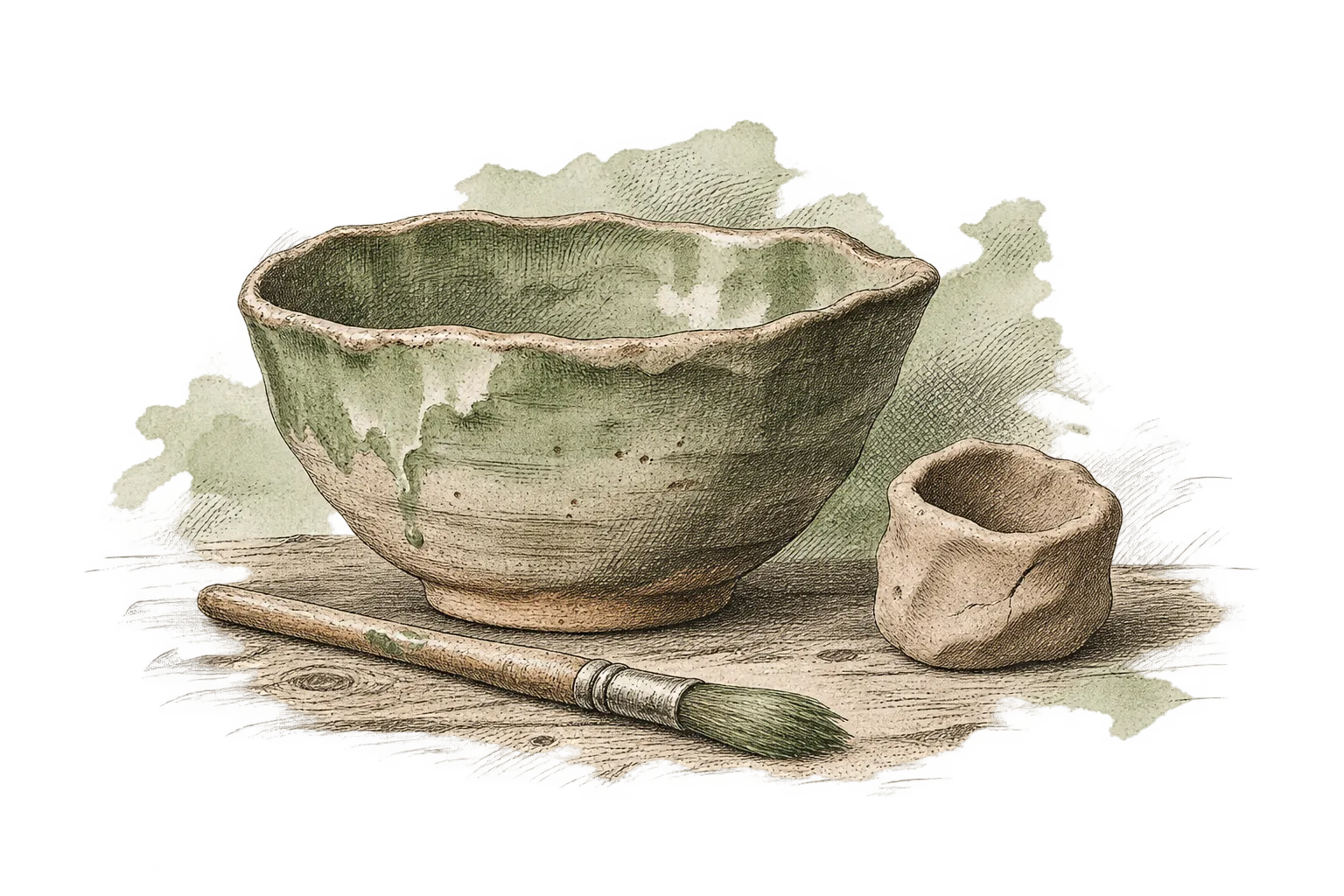
Imagine someone who enjoys making pottery. This is a hypothetical example: they choose what to make, experiment with a shape, and leave an imperfect bowl on a shelf. If they start taking orders, they also have to think about pricing, delivery dates, consistency, and what customers want.
They may enjoy those responsibilities. They may also find that the activity they loved has become a different kind of work. The clay hasn't changed, but the terms of spending time with it have.
What the research says
When I became a father for the first time, I read Özgür Bolat's Beni Ödülle Cezalandırma to better understand how rewards affect children's motivation. Its discussion of how rewards can undermine motivation comes to mind when I hear someone being encouraged to monetize a hobby. Bolat discusses research by Edward Deci and Mark Lepper, among others [Beni Ödülle Cezalandırma, book preview in Turkish].
When drawing comes with an award
One concrete example is a 1973 experiment by Mark Lepper et al. They studied preschool children who already enjoyed drawing. Some were offered an award in advance, some received an unexpected award afterward, and others received no award. Later, during free play, the children who had expected an award showed less interest in drawing than children in the other two groups [Lepper et al.].
The researchers called this the overjustification hypothesis: an external incentive can become the apparent reason for doing something that was already enjoyable. The child may come to see drawing as something done for an award. When the award is absent, the activity has lost some of its pull.
An aside from Bolat's book: He tells a story about an older man bothered by children making noise outside his home. The man starts paying them to make the noise, then gradually reduces the payment and finally stops. The children stop too: they no longer want to do it for free. The story turns the idea around, using a reward to undermine an activity someone wants to discourage. (FYI: this illustrates a proposed mechanism, not a scientifically established way to change a child's behavior.) [Beni Ödülle Cezalandırma, pp. 22-23].
How rewards can change motivation
A related explanation comes from cognitive evaluation theory. It considers how rewards affect our sense of autonomy and competence. A reward experienced as control can weaken intrinsic motivation; feedback that supports competence without controlling the person can have a different effect [Self-Determination Theory].
In 1999, Edward Deci et al. reviewed 128 experiments. They found that promising money or prizes could make people spend less time on an activity once the rewards stopped, even when they were free to continue. Encouraging feedback about their performance could have the opposite effect and increase their interest. The results depended on what was offered and how it was presented [Deci et al.].
What we can conclude about hobbies
Researchers disagree about how broadly these effects apply. Cameron et al. found that reduced motivation occurred under particular conditions, and later research also emphasized the importance of the activity and how rewards were offered [Cameron et al.; Promberger and Marteau].
My takeaway is simple: enjoyment is already a reason to keep doing something. Adding money deserves a deliberate choice, not an automatic recommendation. These studies don't settle whether someone should turn a hobby into a business. They give us a reason to consider what might be lost alongside what could be earned. We owe it to ourselves to protect what we value, and we don't need to justify keeping a hobby just for ourselves.
Why do we ask about money so quickly?
I think part of the answer lies in the relationship between money, recognition, and satisfaction. Money gives us a familiar way to recognize value. Saying "you could sell this" can be a compliment. It is harder to measure the satisfaction of learning a difficult passage of music or spending an afternoon making something nobody needs.
There must also be a connection to how we find our place in society. Money gives us a visible way to compare progress and show that other people value what we do. That could help explain why we so quickly translate "I enjoy making this" into "Could I earn from it?" The satisfaction itself is harder to show.
These are my interpretations, not findings from the studies above. Financial pressure also matters. For someone who needs additional income, a hobby may offer a practical opportunity. Keeping an activity separate from earning is easier when there is less pressure to make it pay.
Still, the question can quietly introduce a standard the person never chose. Now a painting needs a customer, or a small software project needs a business model. I would rather first ask what they enjoy about it.
Let the person choose the terms
Although there is nothing wrong with earning from a hobby, the useful question is whether the person wants the work that comes with earning from it. Selling an occasional piece, teaching a class, and running a business create different obligations.
If someone wants to try, a small experiment may help them notice which parts they enjoy and which they want to protect. They might keep some projects free of deadlines or commissions. They might discover that customers add meaning to the work. Either outcome is more informative than assuming monetization is the natural next step.
In the video I mentioned at the start, "the Jev guy" also looks back at the early internet while discussing cursed software: strange websites, questionable ideas, and people making things simply because they could.
Some of those experiments may lead somewhere useful. Others may give their makers an enjoyable afternoon and nothing more. I think there's room for both, in software and in hobbies generally.
We don't need to know what something will become before we let ourselves enjoy making it. So don't be ashamed to have or defend your "useless" hobbies.